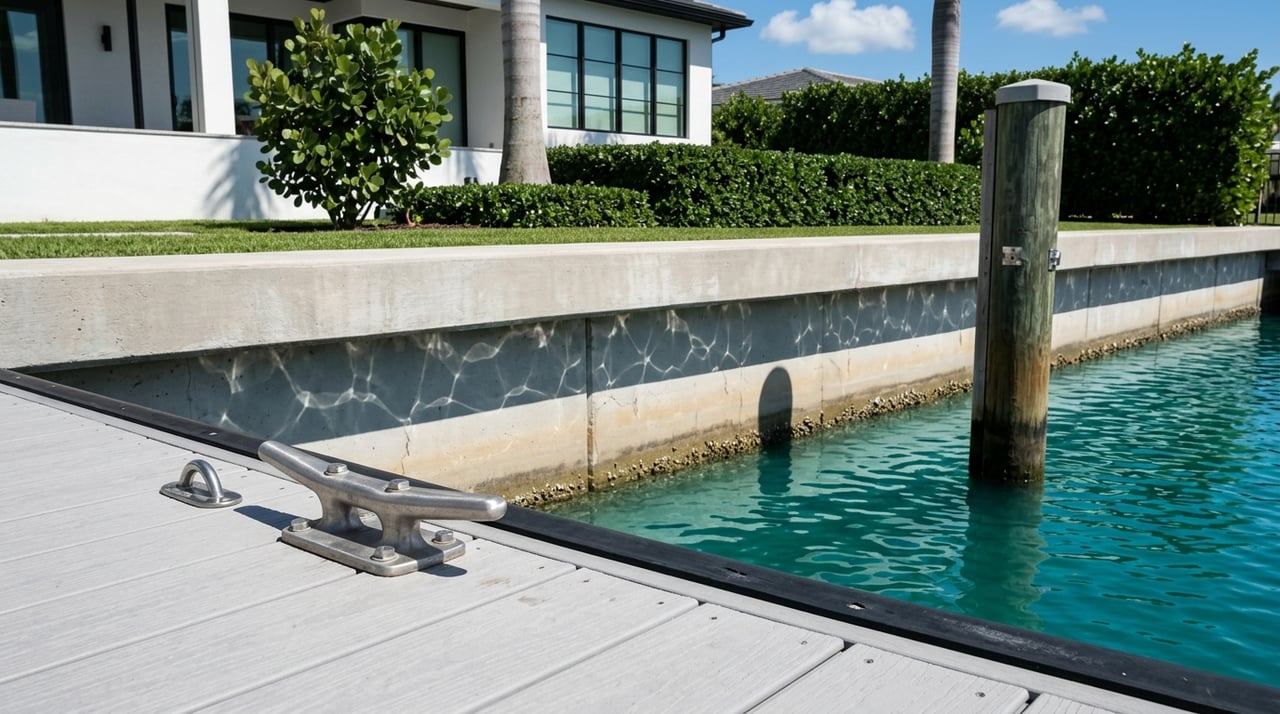
What to Check Before Buying North Palm Beach Deep Water Docks
May 28, 2026
May 28, 2026
If a home in North Palm Beach comes with a deep-water dock, it can be tempting to treat that feature as a simple bonus. In reality, the dock, lift, and seawall may affect how you use the property, what improvements are allowed, and what future costs you may face. Before you buy, you need to know whether the waterfront setup truly works for your boat and whether it is properly permitted, structurally sound, and aligned with local rules. Let’s dive in.
In North Palm Beach, a dock is a regulated improvement, not just an amenity. The Village requires building permits for docks, piers, mooring devices, and boat lifts, and the permit package calls for signed and sealed construction documents from a Florida engineer.
The Village also requires a current boundary survey with the proposed work shown on it, along with DEP materials and other supporting documents. For seawalls and bulkheads, engineer-prepared plans, Village Engineer review, and milestone inspections are also part of the process.
That means a waterfront property can look turnkey while still carrying documentation gaps, outdated approvals, or physical issues that deserve closer review. For buyers in the luxury market, that is not a minor detail. It is part of understanding what you are really purchasing.
North Palm Beach measures dock and pier limits from the rear property line and the bulkhead face. Because of that, an accurate survey is one of the first documents you should review.
Under Village rules, a standard dock may extend up to 5 feet waterward from the bulkhead wall. In the North Palm Beach Waterway, a floating dock may extend up to 10 feet, but mooring on that extended floating section is limited to loading and unloading.
The code also sets different limits for piers, mooring posts, buoys, and floating anchors depending on the waterway. Two homes that seem similar on paper can have very different docking envelopes based on where they sit.
For seawalls and bulkheads, the Village requires reinforced or prestressed concrete construction and continuous reinforced caps. The engineering must account for hydrostatic pressure, stormwater runoff, surcharge loads, toe erosion, and backflow prevention where applicable.
The code allows certain seawall or bulkhead reconstruction up to 18 inches waterward of the property line in specific situations. If work goes farther waterward than that, Village Council approval through the fill-permit process is required.
For you as a buyer, this matters because older or altered shoreline structures may not meet current standards. A seawall that looks acceptable at first glance may still deserve engineering review.
Before closing, ask the seller for the permit number, final inspection sign-off, as-built drawings, and any exemption or verification letters tied to the dock, lift, or shoreline work. This is especially important if the dock appears newer, the lift was added later, or seawall work was recently completed.
At the state level, Florida DEP regulates many alterations to land and water resources through its ERP program unless an activity is specifically exempt. A single-family dock may qualify for self-certification exemption in some cases, including certain new docks, repairs or replacements, or boat-lift additions.
Other projects may require exemption verification, a general permit, or an individual permit. The key point is simple: do not assume that a finished dock means a fully cleared file.
Some sites face additional review because of environmental designations. DEP notes that exempt docks and general-permit docks may still be subject to aquatic-preserve design criteria, and some individual ERP permits may include state-owned submerged-lands authorization.
Palm Beach County is also a manatee-protection county with an approved Manatee Protection Plan. County environmental resources materials note that manatees are found year-round in county waterways, including Lake Worth Lagoon, which can affect how agencies review new or expanded boat facilities.
If a property falls under a special-waterway rule set, your due diligence should account for that before you decide a dock can be modified, enlarged, or reconfigured later.
The most important dock question is often the most practical one: can you actually keep your vessel there at the water levels you expect to use? A handsome dock is not enough if the depth, approach, or turning area does not support your boat.
NOAA charts and Coast Pilot materials can help you understand channel descriptions, bridge clearances, currents, tides, water levels, and navigation hazards. In North Palm Beach, that information is a useful starting point, but it should not replace a site-specific marine survey or soundings.
If you plan to keep a larger boat at the property, verify usable depth at the lowest practical tide, not just at a favorable moment during a showing. Real boating utility is what matters.
A deep-water label should be tested against real-world use. You will want to confirm not only depth at the dock, but also how the vessel will approach, turn, and leave the property.
That review can be especially important in canal settings, where nearby structures, local width, and dock placement may affect maneuverability. In high-value waterfront purchases, function should lead the analysis.
A seawall can appear clean and well maintained while still showing signs of deeper issues. North Palm Beach’s rules require design consideration for hydrostatic pressure, surcharge loading, toe erosion, and drainage backflow, so structural performance matters.
Warning signs can include cap settlement, cracking, corrosion, voids behind the wall, undermining at the toe, and a wall that is visibly out of plumb. If the seawall is older or has been recently altered, ask for the geotechnical report and permit closeout documents.
That gives you a better basis for evaluating condition than relying on a seller disclosure alone. On waterfront property, paperwork and physical inspection should support each other.
If the property includes a lift, confirm that the lift work has the right approvals. The Village’s dock and boatlift permit checklist calls for boatlift spec sheets, an electric sub-permit for boatlifts, and insurance certificates where applicable.
This is one reason waterfront due diligence should be detailed. A dock can look complete and still be missing electrical documentation, lift approvals, or final inspection records.
Waterfront hard-structure costs can become material quickly. Published Florida shoreline cost data show bulkhead installation at roughly $265 to $1,022 per linear foot, with maintenance around $240 to $800 per linear foot.
The same Florida manual also cites an industry range of about $100 to $400 per linear foot for repairs and $500 to $1,000 per linear foot for retaining-wall replacement, depending on design and site conditions. Those figures are not a quote for your property, but they do illustrate why seawall condition deserves careful attention during negotiations.
Insurance is another area to review before you are deep into the transaction. FEMA states that homeowners insurance does not typically cover flood damage and that flood insurance is generally a separate NFIP policy.
FEMA also notes that there is typically a 30-day waiting period before an NFIP policy takes effect. In practice, you should ask your carrier how the dock, lift, seawall, and detached improvements are treated, and whether windstorm or named-storm deductibles create additional exposure.
A dock can add meaningful appeal, but value is not based on the simple fact that one exists. Waterfront valuation is more nuanced than that.
The Appraisal Institute describes waterfront properties as complex, and appraisal practice often relies on qualitative judgment for unique properties. FHFA also notes that appraisals rely heavily on comparable sales, so the market tends to reward legal certainty, real boating utility, and overall marketability.
In other words, a properly permitted dock with usable depth and a sound seawall may support value more clearly than a larger but uncertain setup. For buyers, that is another reason to focus on function first.
If you are evaluating a deep-water property in North Palm Beach, keep your review focused on the items that can most affect use, cost, and future flexibility:
Complex waterfront purchases call for more than a quick visual review. In North Palm Beach, local code, state environmental review, structural condition, and boating practicality all intersect.
That is why a disciplined process matters. When you evaluate the dock, seawall, permits, depth, and future costs together, you can make a more confident decision about whether a property truly functions as a deep-water home.
If you are weighing a waterfront purchase in North Palm Beach and want discreet, experienced guidance on deep-water property evaluation, Ann Cusa offers a private, client-first approach shaped by decades of South Florida waterfront experience.
Stay up to date on the latest real estate trends.


Get assistance in determining current property value, crafting a competitive offer, writing and negotiating a contract, and much more. Contact me today.