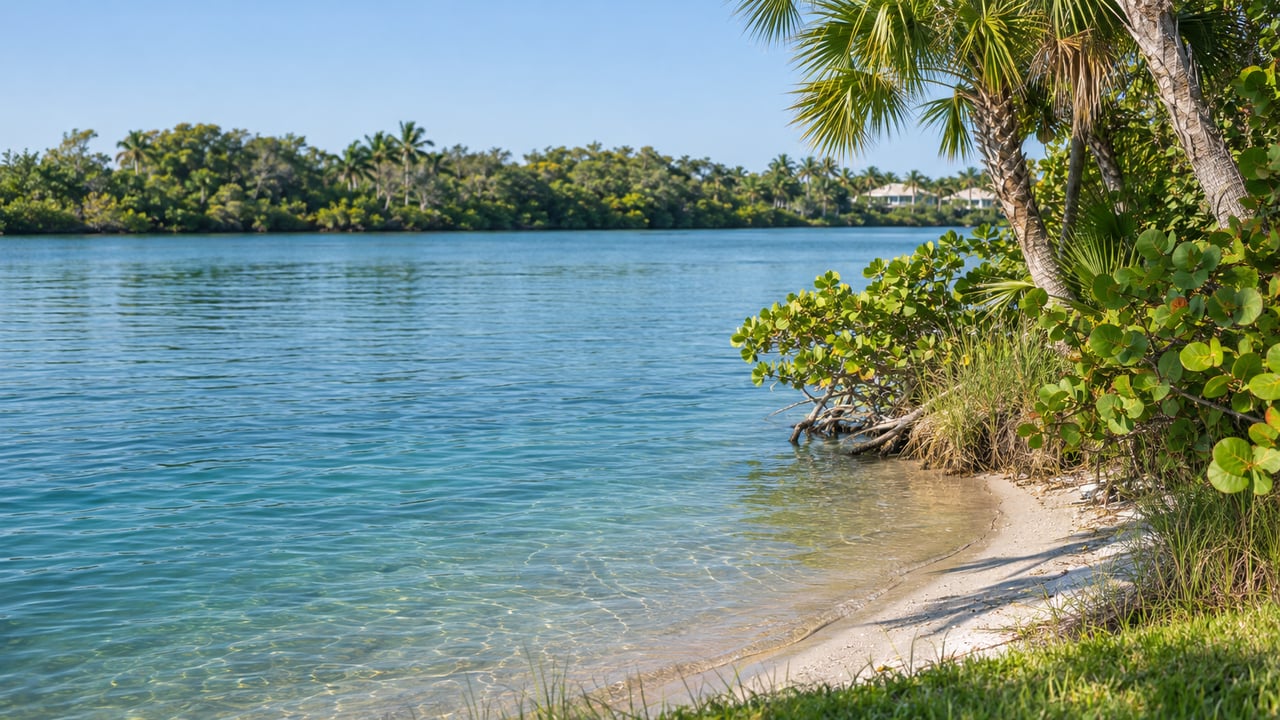
Jupiter's Last Open Waterfront Has a December Deadline. The Price Depends on the Vote.
November 12, 2026
"We did not approve anything tonight," Mayor Jim Kuretski said at the end of the Oct. 29 Jupiter Town Council meeting, as JupiterDaily reported. The council had just voted 4-1 to advance four ordinances for the Sperry Parcel at 961 and 997 N. A1A, the 10.5-acre waterfront site long known as Suni Sands. Councilor Ron Delaney cast the only no vote each time.
The mayor was right about the procedure, since a first reading adopts nothing. The vote still put a deadline on the table. Under a January 2026 settlement between the town and the property owners, either side may cancel by written notice if the council rejects the applications, approves them over the owners' objections, or has not voted by Dec. 31, 2026. Dec. 31 is six weeks after the council's Nov. 17 meeting. Under that agreement, the price of the public's share of this shoreline is tied to how the council votes on the private share.
Over the last 13 years, the Suni Sands site has carried four very different numbers. They differ because each one assumes something different about what can be built there.
| Figure | Amount | Source and context | Implied per acre |
|---|---|---|---|
| 2013 purchase by Charles Modica | $17 million for 10.4 acres | Stet News, Jan. 26, 2026 | about $1.6 million |
| Town's settlement price for the view corridor | $10.5 million for about 1.41 acres | Mediation settlement, Jan. 20, 2026 | about $7.4 million |
| Modica's recent fair-market-value estimate for the whole site | about $130 million | Stet News, Oct. 30, 2026 | about $12.4 million |
| Town attorney's estimate of potential takings exposure | potentially more than $100 million | Stet News, Jan. 26, 2026 | n/a |
Stet News reported the 2013 purchase price. It also reported that both sides describe the $10.5 million view-corridor price as a deep discount. Modica's $130 million estimate came up at the Oct. 29 hearing, when he renewed an offer to sell the whole property to the town at fair market value with what he called attractive financing, according to Stet News. Kuretski said the town cannot afford to buy the entire property.
The last row explains why the settlement exists at all. In July 2023, the council issued a certificate to dig that allowed building on 6 acres. Modica appealed, which started the mediation in November 2023. Town Attorney Tom Baird told the council that Modica "was alleging the order would result in an unconstitutional taking of his property." Stet reported that if a court agreed, the town could be required to pay fair market value for land potentially worth more than $100 million. "The risk to the town in terms of the potential liability was great," Baird said.
The per-acre figures follow a simple pattern. Land bought for about $1.6 million an acre as a former mobile home park reaches about $12.4 million an acre in the owner's estimate. The town's 1.41 acres fall in between at roughly $7.4 million an acre, and the settlement makes that price available only if the council approves the development without the owners objecting.
The settlement agreement states the condition directly:
If the Town Council votes to not approve the Applications or to approve the Applications with objections from the Property Owners, or does not vote on the Applications by December 31, 2026, either party may cancel this Agreement by sending written notice to the other.
The public benefits depend on approval. If the applications are approved without objections from the owners and with the specified deed restrictions, the owners convey the 4.07-acre midden parcel to the town and sell it the roughly 1.41-acre view corridor for $10.5 million. The deed restrictions are strict. The view corridor is limited to conservation, open space or a passive park, with no structures more than 15 feet above existing grade. The midden parcel allows no structures and only pedestrian access for town-sponsored educational, cultural, historic, ceremonial and archaeological uses. The settlement also preserves a strip 950 feet long and 9.5 feet wide where the Celestial Railway crossed the property from 1889 to 1895.
The land transfers within 90 days of the final approval date, including any time needed to resolve third-party appeals. The owners then dismiss their state land-use dispute claim within 30 days after that closing.
Philippe Jeck, Modica's attorney, described the trade at the hearing, as JupiterDaily reported. He said that for the first time in 125 years, more than half the property would become public under the settlement. Vivien McLean-Bunce, president of the Jupiter Inlet Foundation, argued that the entire shoreline should be designated conservation, which matches the Planning and Zoning Commission's recommendation. Both positions are about the same 10.5 acres. They differ on whether the shoreline should be gained through a development approval or protected without one.
The development half of the deal is about 5 acres. Modica's plan calls for a 110-key hotel with 100 rooms plus 10 lock-off units, 44 residential condominiums, a restaurant, retail, a spa and a 17-slip marina limited to hotel guests and residents. The site sits north of N. A1A and east of Clemons Street. It once held the 130-unit Suni Sands mobile home park, and those homes have since been removed.
Town planning staff told the council the PUD as filed was inconsistent with Jupiter's comprehensive plan. Staff also said the proposed marina and docks could interfere with views of the Jupiter Inlet Lighthouse. A marina in this district requires a separate special exception decided case by case, and the land-use change alone does not grant marina rights. The public turnout was lopsided. JupiterDaily, citing Stet News, counted nearly 40 speakers opposed and one resident in favor.
Modica's position at the hearing explains why the plan cannot shrink much further. "I am at my personal extreme limits of what is economically plausible on this site," he told the council. That sets the limit for negotiation. Each acre moved to conservation or each foot of Riverwalk restored raises the cost of the acres left for building, and the land transfers depend on an approval the owners do not object to.
Three versions of the land split are now on record, and the council will have to settle on one.
| Element | As filed | Planning and Zoning recommendation | Mayor's stated direction |
|---|---|---|---|
| Riverwalk Corridor | 142 linear feet, down from 535 | Keep 535 feet | "Less than 250" |
| Inlet Village Flex land | 5.0 acres | 4.3 acres | n/a |
| Conservation land | 5.5 acres | 6.2 acres | n/a |
| Traffic | No cap | n/a | Supports a trip cap, number to be set |
Staff recommended the trip cap to protect two-lane A1A and its level of service. The applicant's traffic engineer objected. The PUD also includes waiver requests covering floor-to-ceiling heights, setbacks for a parking garage, pool, patio and deck, a second story on the waterfront amenity building, and tandem parking. Revisions, and possibly more public benefits, are expected before second reading. Each of these adjustments has to clear the "without Property Owners objections" condition in the settlement. That condition gives the owner's economics a direct role in how far the council can go.
Modica developed the nearby Love Street project. In 2016, The Palm Beach Post described the approved plan as about 50,000 square feet of retail, restaurant and office space in roughly 12 one- and two-story buildings with 262 parking spaces. The plan also included a boardwalk, a public promenade and a connection to the town's Riverwalk. The Post reported at the time that public beach access, Riverwalk access and kayak rentals were promised benefits but not guaranteed.
Charlie & Joe's at Love Street opened on Feb. 18, 2021, after construction began in 2019. At opening it included Beacon, Lucky Shuck Oyster Bar & Taphouse, Topside at the Beacon and Tacklebox Seafood & Supply Co., and Modica said six dock slips were reserved for commercial fishermen. The Love Street precedent shows how public elements were documented in an earlier Modica approval. That matters now, because the Suni Sands settlement puts its public elements into deed restrictions and a purchase price.
For anyone weighing a home near the Inlet, this sequence affects the A1A traffic load, the length of the public Riverwalk, the view toward the Lighthouse and the number of boat slips near the mouth of the Loxahatchee.
Is Suni Sands approved for construction? No. The Oct. 29 votes were first readings only, and nothing has been built, approved for construction or finally adopted.
Is the town buying the whole site? The settlement covers only the 1.41-acre view corridor at $10.5 million, and only if the applications are approved without objections from the owners. Modica's offer to sell the full site at fair market value is a separate matter, and the council has asked for its terms to be made public.
What history is on the site? Archaeologists have found evidence of Indigenous people living there thousands of years ago. From 1889 to 1895, the site was the terminus of the Celestial Railway.
This summary of the settlement and ordinances is general information, not legal advice. Anyone whose property or purchase could be affected should review the documents with their own attorney.
Entitlement deals like Suni Sands affect values well beyond the parcel itself, and judging that effect is where developer experience helps. If you own or are considering a home near the Jupiter Inlet and want to understand what the December outcome could mean for it, Ann Cusa can walk you through it. Request a Private Consultation.
Stay up to date on the latest real estate trends.
Get assistance in determining current property value, crafting a competitive offer, writing and negotiating a contract, and much more. Contact me today.